
PLG vs Sales-Led vs Hybrid GTM: Choosing Your SaaS Motion (2026)
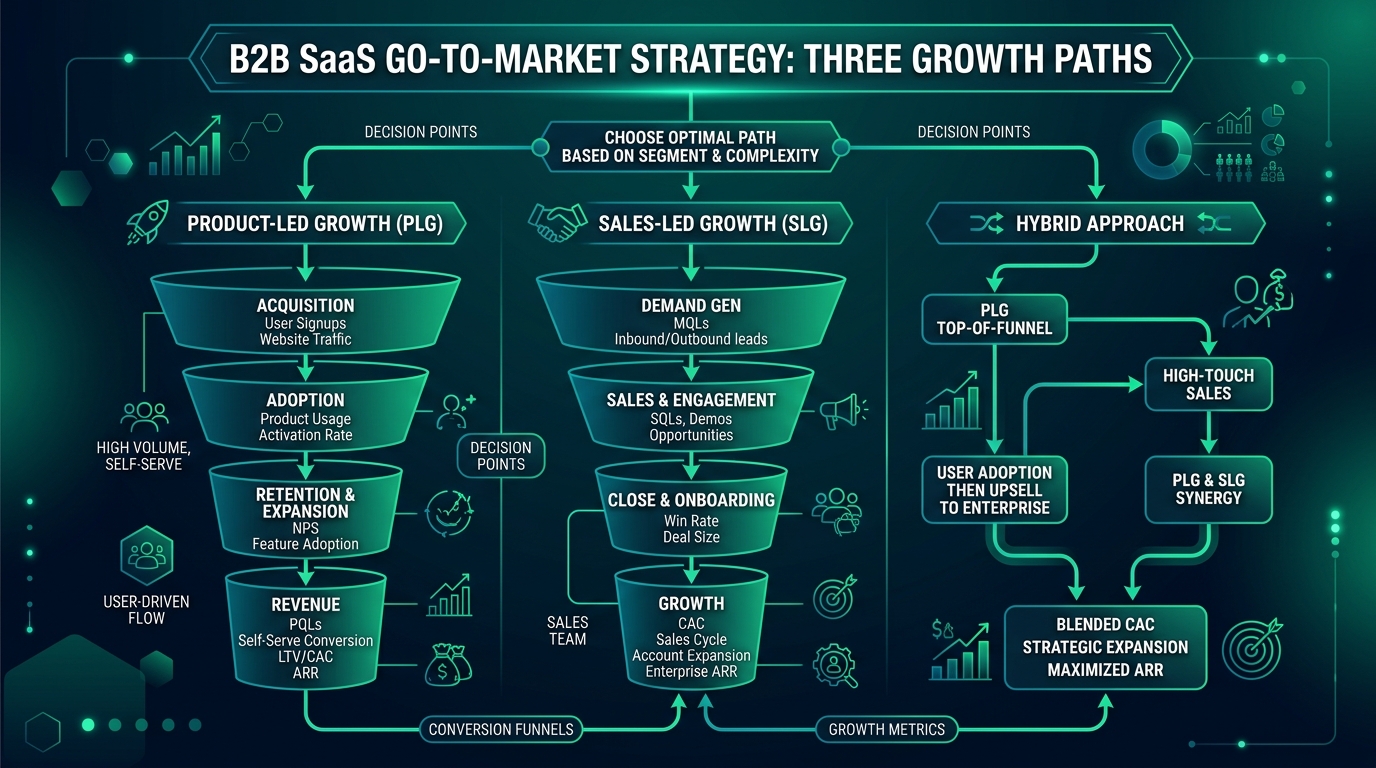
We need to talk about the massive lie Silicon Valley has been selling for the last five years. If you listen to the echo chamber on LinkedIn, you'd think every SaaS company is a pure Product-Led Growth (PLG) unicorn that just scales on autopilot. No sales reps. No friction. Just a magical self-serve funnel printing money while the founders sleep.
It's nonsense.
At Sotros, we've audited dozens of GTM engines, and what we actually see behind the curtain is very different from what most guides say. The reality? Pure PLG is incredibly hard to pull off past a certain scale, and pure Sales-Led Growth (SLG) is too expensive for lower ACV products. The truth lies in the messy, complicated, but highly profitable middle: The Hybrid GTM motion.
If you're reading this, you are probably trying to figure out which motion to choose for your B2B SaaS in 2026. You might have a product that users love, but you are struggling to move upmarket. Or maybe you have a top-down sales engine, but your CAC is spiraling out of control, and you need a product-led acquisition funnel.
Let's kill the theory and look at the hard data. We'll break down why 67% of B2B SaaS companies over $10M ARR use a hybrid motion, how to map your GTM to your ACV, and what it actually takes to build a revenue engine that scales in the modern era.
The Big Data: Why Hybrid is Eating Software
Let's start with a hot take: You don't have a PLG company or a Sales-Led company. You have a revenue target, and you need to figure out the most efficient way to hit it.
According to recent benchmarks, 67% of B2B SaaS companies that have crossed the $10M ARR threshold have adopted a hybrid GTM motion. Why? Because single-channel dependency is a massive risk.
Here is what the numbers look like when we compare performance across motions:
- Net Revenue Retention (NRR): Hybrid companies hit their NRR targets 67% of the time, compared to just 58% for pure-PLG companies.
- CAC Payback: The industry median CAC payback period sits around 15 months (though your target should be <12 months). Hybrid motions, when optimized with Product-Qualified Leads (PQLs), often achieve better payback periods by lowering acquisition costs at the bottom of the funnel.
- LTV:CAC Ratio: The baseline is 3:1, but top-tier SaaS companies running optimized hybrid engines push this above 4:1.
For an extensive breakdown of retention metrics, check out our guide on B2B SaaS Net Revenue Retention: NRR Benchmarks.
When you rely entirely on a self-serve motion, you leave massive enterprise deals on the table because buyers at that level want to talk to a human. They need security reviews, custom SLAs, and complex implementation plans. Conversely, if you rely entirely on outbound sales, you are burning cash paying account executives to close $2,000 deals.
The most successful companies—think Slack, Dropbox, Atlassian, and Datadog—all started with a product-led wedge and layered on a sophisticated sales engine. OpenView's PLG Index has tracked this for years: the market cap of companies utilizing hybrid motions dwarfs those sticking to a single lane.
The Framework: Mapping ACV to Your GTM Motion
The biggest mistake we see founders make is choosing a GTM motion based on their personal preference rather than the fundamental unit economics of their business. Your Annual Contract Value (ACV) dictates your GTM motion. Period.
If you try to run a high-touch sales motion on a $1,000 ACV, you will go bankrupt. If you try to run a pure self-serve motion on a $100,000 ACV, you will close zero deals.
Here is the breakdown we use at Sotros:
1. ACV < $5,000: Pure PLG
When your deal size is this small, you cannot afford to have a human involved in the sales process. The math simply does not work.
- The Focus: Frictionless signups, rapid Time-to-Value (TTV), and viral loops.
- The Funnel: Freemium or free trials leading to self-serve credit card checkouts.
- The Reality: You need massive top-of-funnel volume. Conversion rates matter immensely here. The average free-to-paid conversion rate in SaaS is ~9%, but freemium models hover around 12%, and optimized free trials can hit 18%+.
2. ACV $5,000 - $50,000: The Hybrid Zone (Product-Led Sales)
This is where the magic happens. Your product is complex enough that some users need hand-holding, but accessible enough that individuals or small teams can get started on their own.
- The Focus: Using the product as the primary lead generation engine, but inserting humans to close larger team or enterprise rollouts.
- The Funnel: Users sign up for a free tier. When they hit a usage limit or show buying intent, they are flagged as a PQL and routed to sales.
- The Reality: This requires deep alignment between product, marketing, and sales. We detail how to price this effectively in our B2B SaaS Pricing Strategy: Usage-Based Models playbook.
3. ACV > $50,000: Sales-Led Growth
At this price point, you are selling to the C-suite. The purchase involves procurement, legal, and massive organizational change management.
- The Focus: Account-Based Marketing (ABM), outbound SDRs, and complex sales cycles.
- The Funnel: Target account lists -> Outbound sequences -> Demos -> Proof of Concept (PoC) -> Closed Won.
- The Reality: Your product is irrelevant until the third meeting. You are selling the outcome and the ROI. For more on optimizing this funnel, read The B2B SaaS CRO Audit Checklist.
PQLs and Activation: The Missing Link
Let's dive deeper into the Hybrid motion, specifically the concept of Product-Qualified Leads (PQLs). If there is one thing you take away from this article, let it be this: MQLs are dead. PQLs are the future.
Marketing-Qualified Leads (MQLs) are based on arbitrary actions: downloading a whitepaper, attending a webinar, or filling out a form. They tell you nothing about whether the prospect actually understands the value of your software.
PQLs, on the other hand, are based on actual product usage. A user is only flagged as a PQL after they have achieved core value—what we call "activation."
The Activation Problem
Here's a terrifying statistic: Only 34% of PLG companies effectively track activation.
If you aren't tracking activation, you are flying blind. Activation is the single most predictive signal for long-term retention and conversion. If a user doesn't activate, they won't pay. If they do activate, they are primed for an upsell. (We wrote a massive deep dive on this: B2B SaaS Product-Led Onboarding).
Defining the PQL
A strong PQL definition requires three components:
- Fit: Does the user match your Ideal Customer Profile (ICP)? (e.g., They work at a company with 500+ employees).
- Activation: Have they reached the "Aha!" moment? (e.g., They invited 3 team members and created 5 projects).
- Intent: Are they exhibiting buying behavior? (e.g., They viewed the pricing page 3 times or hit a usage limit).
When you hand a sales rep a list of PQLs, it changes the entire dynamic of the conversation. They aren't cold-calling; they are calling a user who already loves the product to help them unlock more value. The data backs this up: Companies with optimized PQL models see 3x higher conversion rates compared to traditional MQL handoffs. Read more on the Product-Led Alliance's guide to PQLs.
The Sales-Assist Model: Humans as Product Enablers
In a hybrid GTM motion, the role of the sales rep fundamentally changes. They are no longer "Account Executives" aggressively pushing for a close. They become "Product Specialists" or "Sales-Assist" reps.
The Sales-Assist model uses product usage data to direct reps to high-intent PQLs.
What Sales-Assist Actually Does:
- Unblocking Users: If a user gets stuck during onboarding, the rep reaches out to offer a personalized onboarding session.
- Navigating Procurement: When a champion inside a company wants to upgrade, the rep steps in to handle legal, security, and procurement.
- Driving Expansion: Reps monitor usage data to identify accounts ripe for cross-sell or upsell. (Learn more in our B2B SaaS Customer Expansion Playbook).
This requires a massive shift in tooling. Your CRM needs to talk to your product database. Sales reps need visibility into what features a user is engaging with in real-time. This is where Revenue Operations (RevOps) becomes critical. You can't run a hybrid motion with a siloed tech stack. If you need help structuring this, review our RevOps Metrics Framework.
The 2026 Shift: AI Agents as Buyers
We can't talk about GTM motions in 2026 without addressing the elephant in the room: AI agents are becoming users and buyers.
For the past decade, we've designed software for human consumption. We built beautiful UIs, intuitive workflows, and self-serve onboarding wizards. But the landscape is shifting. We are entering an era where AI agents—deployed by companies to automate workflows—are the ones interacting with your SaaS.
What This Means for GTM:
- Agent-Readable Surfaces: Your product needs an API-first approach, but more than that, it needs to be easily navigable by autonomous agents. If an AI agent can't figure out how to provision a seat or pull a report, it will recommend a competitor's tool.
- New Pricing Models: Per-seat pricing is dying. When AI agents do the work of 10 humans, you can't charge by the seat. We are moving toward outcome-based or pure usage-based pricing models.
- Automated Procurement: AI agents will soon be authorized to make low-level purchasing decisions. Your PLG motion needs to accommodate machine-to-machine transactions.
This is a wild frontier, but it's happening faster than most founders realize. If you're building a GTM strategy today, you have to account for non-human buyers. (For a glimpse into how AI is already changing lead gen, see our post on AI Chatbot Lead Generation for B2B).
Validate PMF and TTV Before Scaling
I cannot stress this enough: Do not pour budget into your GTM engine until you have validated Product-Market Fit (PMF) and Time-to-Value (TTV).
We see so many series A startups raise a $10M round and immediately hire a VP of Sales and 10 AEs. Six months later, they miss every revenue target because the product is leaky, users aren't activating, and the AEs are churning.
Before you scale:
- Prove the Wedge: Can you acquire users cheaply?
- Prove the Value: Do those users activate quickly?
- Prove the Expansion: Do activated users stay and buy more?
Only when you have predictable answers to these three questions should you step on the gas. Focus on net-new ARR and NRR. Ignore the vanity metrics like website traffic or total free signups. To understand the true health of your GTM motion, you must master How to Calculate CAC, LTV, and Payback Period.
Common Mistakes in GTM Motion Selection
Let's wrap up with some rapid-fire mistakes we see constantly at Sotros:
- The "We'll Just Add PLG" Fallacy: You can't just slap a "Start Free Trial" button on an enterprise software product and call it PLG. PLG requires a fundamental rethinking of product design, onboarding, and pricing. It's a company-wide initiative, not a marketing tactic.
- Ignoring the Hand-Raiser: Even in a pure PLG motion, some users just want to talk to sales. If you hide your "Contact Sales" button, you are losing money. Always offer a fast track to a human for high-intent buyers. HubSpot's sales methodology emphasizes meeting the buyer where they are.
- Compensating Sales Incorrectly: If you run a hybrid motion but compensate sales reps heavily on closing small, self-serve deals, they will inject friction into the PLG funnel to get their commission. You have to align compensation with the behavior you want. Pay reps for expansion and enterprise lands, not for cannibalizing the self-serve funnel.
The Bottom Line
Choosing the right GTM motion isn't about following the latest trend; it's about aligning your product, your pricing, and your customer's buying preferences into a cohesive revenue engine.
For 67% of SaaS companies that reach scale, that engine is hybrid. It combines the efficiency of product-led acquisition with the closing power of human-assisted sales. It relies on PQLs, tight RevOps alignment, and an obsession with activation.
If your current GTM motion is stalling, or if your CAC is spiraling out of control, you don't need a new marketing campaign. You need a structural audit of your revenue engine.
At Sotros Infotech, we help performance marketing teams and RevOps leaders tear down inefficient silos and build GTM engines that actually work.
Deep Dive: The Anatomy of a World-Class RevOps Engine for Hybrid GTM
Transitioning from a pure PLG or SLG model to a hybrid motion is where most companies fail. The failure rarely happens at the strategy level; it happens in the execution. Specifically, it happens because the underlying data architecture—the Revenue Operations (RevOps) engine—is fractured.
Let's break down exactly what a world-class RevOps engine looks like for a hybrid SaaS company in 2026. This isn't theoretical; this is the exact architecture we implement for high-growth clients.
1. The Unified Data Layer
In a traditional setup, marketing lives in HubSpot or Marketo, sales lives in Salesforce, and product data lives in Amplitude or Mixpanel. The systems don't talk to each other in real-time.
In a hybrid motion, delayed data is useless data. If a user hits a paywall and triggers a PQL event, the sales rep needs to know immediately, not 24 hours later when the batch sync runs.
You need a unified data layer (often a Customer Data Platform like Segment or a modern data warehouse architecture using Reverse ETL tools like Census or Hightouch).
- The Goal: Pipe real-time product usage data directly into the CRM.
- The Result: A sales rep opens a contact record and sees exactly what features the user engaged with in the last 15 minutes.
2. Dynamic Lead Scoring vs. Static Thresholds
Most companies use a static lead scoring model. E.g., Download eBook = +10 points. Log in 3 times = +20 points. Reach 50 points = MQL.
This is outdated. A hybrid motion requires dynamic, machine-learning-driven scoring models. The system needs to analyze historical conversion data to identify the specific sequence of actions that predict a purchase.
- Example A: A user logs in every day but only uses one free feature. (Low intent to buy, high engagement).
- Example B: A user logs in once, invites three colleagues, and integrates your tool with their Slack workspace. (Massive intent to buy, high activation).
Your RevOps engine must automatically differentiate between these two users and route Example B to an enterprise rep immediately.
3. Compensation Alignment
We touched on this earlier, but it deserves its own section. If you want to destroy your hybrid GTM motion, implement a misaligned commission structure.
If a self-serve checkout is perfectly viable for a $2,000 ACV deal, your sales reps should not be comped on closing that deal. If they are, they will intentionally hide the self-serve checkout link and force the user onto a demo call, ruining the customer experience and inflating your CAC.
The Hybrid Compensation Model:
- Self-Serve: 100% automated. Reps get zero commission.
- Sales-Assist: Reps intervene to unblock a user or answer technical questions. They receive a small bonus or a heavily reduced commission if the deal closes.
- Enterprise/Expansion: Reps actively hunt within the existing user base, find high-value accounts, and navigate complex procurement. They receive full commission on the expansion ARR.
4. The Activation Playbook: A Step-by-Step Guide
Because activation is the most critical metric in a PLG/Hybrid motion, let's break down how to actually improve it. You can't just hope users figure out your software.
Step 1: Define the 'Aha!' Moment mathematically. Don't guess. Look at your retention cohorts. What action do users take in their first 7 days that correlates with a 90% retention rate at month 6? For Slack, it was 2,000 messages sent. For Dropbox, it was 1 file uploaded in 1 folder on 1 device.
Step 2: Strip away all non-essential onboarding. When a user signs up, they are highly motivated but easily distracted. If your onboarding wizard asks them to set up their profile picture, fill out their company details, and watch a 5-minute welcome video before they can use the core feature, they will churn. Get them to the 'Aha!' moment in as few clicks as humanly possible.
Step 3: Implement progressive disclosure. Don't show the user every feature at once. The UI should be incredibly simple on day one. As the user activates and demonstrates competence, slowly introduce advanced features. (This is a core principle in B2B SaaS Product-Led Onboarding).
Step 4: Use triggered in-app interventions. If a user stalls before reaching activation, your product should automatically intervene. This isn't an email blast; it's a contextual in-app message. "It looks like you're trying to set up a workflow. Here is a 30-second template to get you started."
5. Managing the Churn Threat
In a hybrid motion, you are constantly balancing top-of-funnel acquisition with bottom-of-funnel retention. Because PLG models lower the barrier to entry, they also lower the barrier to exit. Churn is naturally higher in self-serve models.
This is why tracking Net Revenue Retention (NRR) is more important than tracking gross retention. You will lose self-serve users; it's inevitable. But if your sales-assist team is successfully upgrading successful accounts to higher tiers, the expansion revenue will outpace the churn.
- Gross Retention: Measures how well you keep revenue from the existing base. (Target: >85%).
- Net Revenue Retention (NRR): Measures total revenue from the existing base, including upsells, minus churn. (Target: >101%, Top tier >110%).
To maintain high NRR, you need a dedicated Customer Success (CS) function that operates differently from traditional CS. In a hybrid model, CS isn't doing basic tech support; they are strategic advisors focused entirely on account expansion and product adoption.
The CEO's Checklist for GTM Evolution
If you are a founder or revenue leader looking to evolve your GTM motion, here is your tactical checklist for the next 90 days:
- Run an ACV Audit: Look at your trailing 12 months of closed-won deals. Group them by ACV. If 80% of your revenue comes from $40k+ deals, but you are spending 50% of your marketing budget on self-serve ads, you have a massive misalignment.
- Define Your PQL: Get sales, marketing, and product in a room. Do not leave until you have a mathematical definition of a Product-Qualified Lead.
- Instrument the Funnel: Ensure your product analytics tool is properly tracking the events that make up your PQL definition.
- Build the Routing Logic: Set up the automation in your CRM so that when a user hits the PQL threshold, an alert is sent to a specific sales rep via Slack or email.
- Pilot the Sales-Assist Role: Take one of your best Account Executives. Take them off cold outbound. Give them the PQL list and tell them their only job is to help those users be successful. Measure the conversion rate after 60 days.
This transition won't happen overnight. It's a fundamental rewiring of how your company goes to market. But if you execute it correctly, you'll build an unstoppable revenue engine that scales efficiently regardless of macroeconomic conditions.
Stop arguing about PLG versus Sales-Led. Embrace the hybrid reality. Build the infrastructure, empower your teams with data, and watch your NRR soar.
Get frameworks like this delivered weekly
Actionable B2B marketing playbooks, benchmarks, and strategies — no fluff.
Get a Free Growth AuditFrequently Asked Questions
How This Fits Into Our Work
This article is part of how we deliver Digital Strategy, Growth Marketing and Revenue Operations for teams in SaaS and B2B. If you're facing similar challenges, we can help you build the infrastructure to address them systematically.