
B2B SaaS Customer Expansion Playbook (2026)
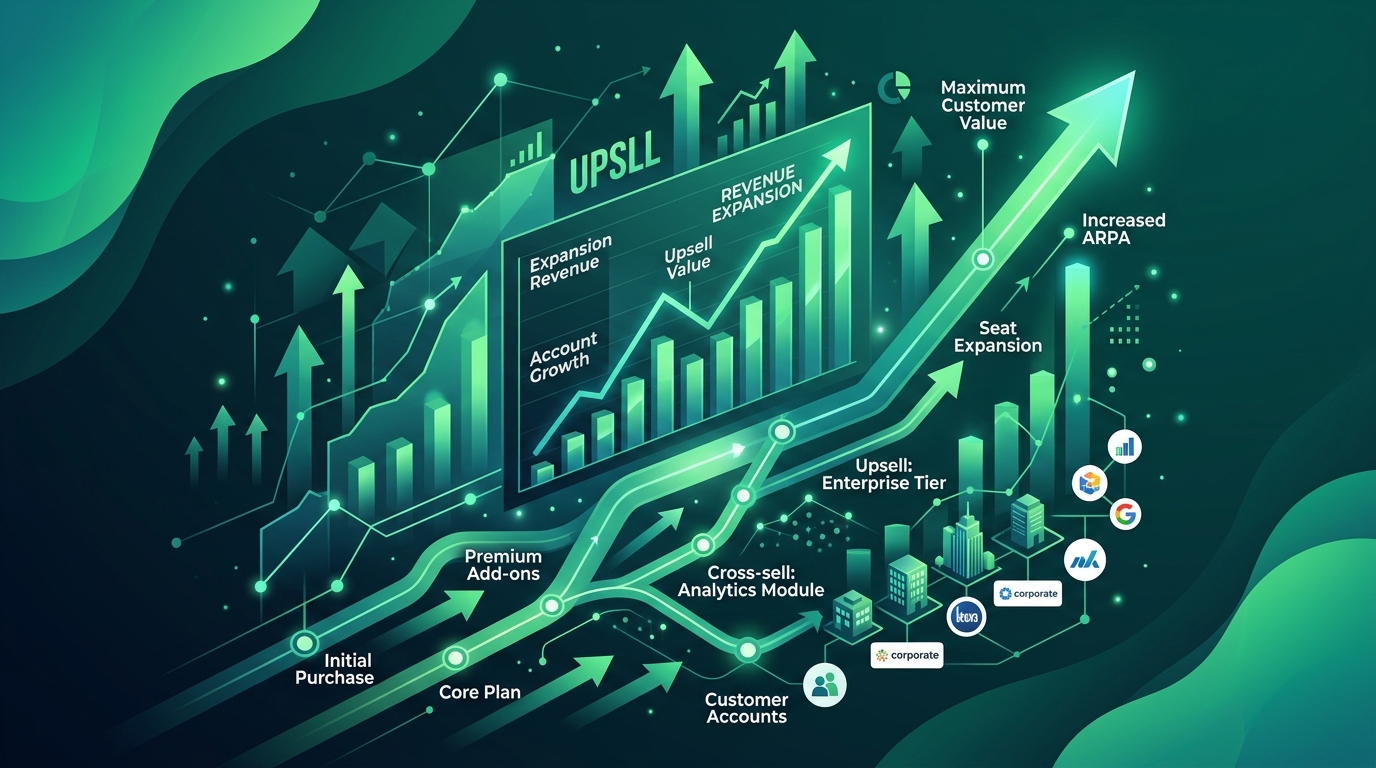
If you're still relying solely on new logo acquisition to hit your revenue targets, you're playing a losing game. At Sotros Infotech, we've seen it time and time again—companies pouring millions into outbound sales motions while ignoring the goldmine sitting right in their CRM.
Let's get real for a second. The days of hyper-growth fueled exclusively by top-of-funnel marketing are over. We're living in an era where capital efficiency isn't just a buzzword; it's a survival requirement. And the single most capital-efficient growth lever you possess? Customer expansion.
The Brutal Math of Expansion CAC
What we actually see in the trenches is a stark contrast to what most traditional sales guides preach. They tell you to keep hunting. We're telling you to start farming—aggressively.
Consider the data: Expansion Customer Acquisition Cost (CAC) sits at roughly $1.00 per $1 of expansion Annual Recurring Revenue (ARR). Compare that to new-logo CAC, which is skyrocketing past $2.00+ for many B2B SaaS organizations.
If you want a deeper dive into the unit economics, our guide on How to Calculate CAC, LTV, and Payback Period for SaaS breaks down exactly why this disparity is growing.
For companies scaling past $50M ARR, expansion ARR doesn't just help the bottom line; it defines it, accounting for >50% of total new ARR. Median SaaS companies are hitting 101-106% Net Revenue Retention (NRR). But the elite? They are soaring at 115-125% NRR.
For more benchmarks, check out our report on B2B SaaS Net Revenue Retention: NRR Benchmarks.
The 4 Expansion Motions (And the One You're Ignoring)
Too many growth teams treat "expansion" as a monolithic concept. It's not. To drive 120% NRR, you need a systematic approach to the four distinct expansion motions:
- Upsell: Moving a customer from a lower-tier plan to a higher-tier plan (e.g., Pro to Enterprise).
- Cross-sell: Selling a complementary product or add-on module to an existing customer.
- Seat/Usage Expansion: Growing revenue organically as the customer adds more users or consumes more platform resources.
- New Buying Centers: Expanding the footprint of your product into entirely new departments, divisions, or subsidiaries within the same corporate hierarchy.
The Forgotten Motion: New Buying Centers
Here's a hot take: You are probably leaving millions on the table by ignoring New Buying Centers. It's the most overlooked, highest-value motion in enterprise SaaS.
Selling an additional 10 seats to the marketing team is great. But what happens when you map the account, identify that the HR team in a different subsidiary is using a competitor, and you oust them? That's not just a seat expansion; that's a strategic land-and-expand victory.
We frequently see companies fail here because they lack cross-account mapping. You need to combine firmographic data with contact data to uncover untapped buying centers. This isn't just a sales job; marketing should be running Account-Based Marketing (ABM) plays against your existing customer base.
Usage-Based Packaging: The End of the Static Seat
Static seat pricing is dying. It creates friction. When a champion has to justify a $500/month increase just to add two junior employees to the platform, expansion stalls.
Usage-based packaging is replacing it, turning expansion into a natural byproduct of product adoption.
- The Old Way: "You've hit your 50-seat limit. Talk to sales to upgrade."
- The New Way: "Your team processed 10,000 transactions this month. Your tier will automatically adjust to accommodate your growth."
If you haven't explored this shift, our deep-dive on B2B SaaS Pricing Strategy: Usage-Based Models is a must-read.
Automating Usage Signals
You can't rely on Customer Success Managers (CSMs) to manually check dashboards to spot expansion opportunities. It doesn't scale. You need automated triggers tied to feature adoption thresholds.
- Signal: Client uses 80% of their allocated API calls within the first 15 days of the month.
- Action: Automated in-app prompt and a notification to the account manager to discuss a volume discount for a higher tier.
The Danger of Masking Churn
Let's talk about the dark side of high NRR.
A company with 120% NRR might look healthy on paper. But what if that 120% is composed of a massive 40% expansion from enterprise accounts, masking a horrific 20% churn rate in the mid-market segment?
Don't mask churn with expansion. You must watch Gross Revenue Retention (GRR) separately. If your GRR is dipping below 85-90%, you have a fundamental product or onboarding issue that expansion is merely hiding.
Before you push for aggressive expansion, ensure your foundation is solid. Review our B2B Customer Retention Marketing: Reducing Churn Playbook to plug the leaky bucket.
GTM Match: Aligning ACV with Expansion Motion
Your expansion strategy must match your Annual Contract Value (ACV).
- <$5K ACV (Product-Led Growth): Expansion must be frictionless, automated, and product-led. Your product is the expansion engine. Read our RevOps Metrics Framework: 12 KPIs That Predict Revenue to track PLG expansion metrics.
- $5K - $50K ACV (Sales-Assisted): A mix of product triggers and CSM intervention. Marketing automation plays a heavy role here.
- >$50K+ ACV (High-Touch Enterprise): Strategic account planning, cross-account mapping, Executive Business Reviews (EBRs), and targeted ABM campaigns are required to break into new buying centers.
Behavioral Intent: The AI Advantage
It's not 2021 anymore. Basic product usage data isn't enough. Elite teams are leveraging AI to monitor behavioral intent and external signals.
- Is your client launching a new department?
- Are they showing massive headcount growth on LinkedIn? (Check out LinkedIn Marketing Solutions for targeting strategies).
- Are they searching for solutions in your adjacent product categories?
By feeding these signals into your CRM (like Salesforce), your revenue teams can anticipate needs before the customer even articulates them.
Expansion is a Product Strategy, Not Just a Sales Tactic
Ultimately, expansion cannot be bolted on at the end of the customer journey. It must be woven into the fabric of the product experience. If your product doesn't naturally guide users toward more advanced features, higher usage, and wider team collaboration, your sales team is fighting an uphill battle.
It's time to shift marketing spend. Leading organizations are allocating up to 53% of their marketing budgets to existing customers. It's time to stop treating "post-sale" as an afterthought.
At Sotros, we build the automated systems and strategic frameworks that turn your existing customer base into your most powerful growth engine.
Need help with performance marketing?
Our team builds performance marketing systems for B2B companies. Get a free strategy review.
Book a Free Strategy CallFrequently Asked Questions
How This Fits Into Our Work
This article is part of how we deliver Revenue Operations, Customer Success and Growth Marketing for teams in SaaS, B2B and Technology. If you're facing similar challenges, we can help you build the infrastructure to address them systematically.