
Google Ads Broad Match in 2026: When It Works, When It Bleeds Budget & How to Control It
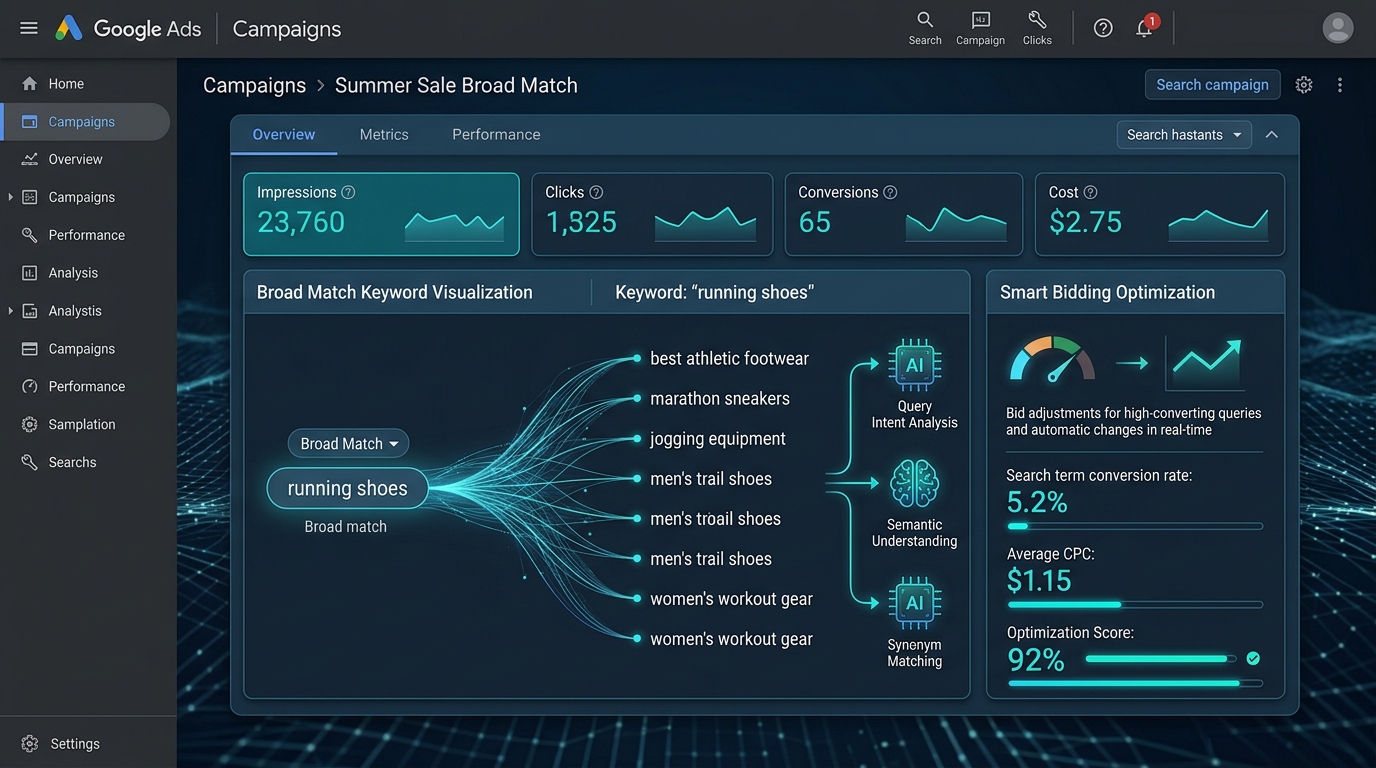
For years, B2B marketers treated Google Ads broad match like a financial hazard. You turned it on, went to lunch, and came back to find your budget drained by searches for "free software for students" and "entry level jobs."
We've seen it happen. After auditing over 50 B2B SaaS accounts at Sotros, the number one culprit of wasted spend is usually an unchecked broad match campaign with a low tCPA target and zero negative keyword hygiene.
But things changed. In 2026, the underlying algorithms driving Google's keyword matching and Smart Bidding are fundamentally different. Broad match isn't just a safety net for low-volume accounts anymore—it's a critical tool for scaling and discovering new search intent. If you know how to control it.
What most guides say: "Trust the algorithm and upgrade all exact match keywords to broad match." What we actually see: If you do that without Offline Conversion Tracking (OCT) and robust negative keyword lists, you will incinerate your budget in 72 hours.
This guide covers exactly when to use broad match in B2B Google Ads, when it will bleed your budget dry, and how to harness it for pipeline growth instead of garbage leads.
The Broad Match Reality Check: When It Actually Works
The golden rule for broad match in 2026 is simple: You need volume, and you need good data.
Google's machine learning needs a consistent feedback loop to understand what a "good" conversion looks like. Without it, the algorithm defaults to the path of least resistance: cheap, low-intent clicks that might convert into a form fill, but never turn into a qualified demo or pipeline.
The Minimum Thresholds
To make broad match work, you need to hit these non-negotiable baselines:
- 15-30 Conversions per Month (Minimum): Per campaign. If you are getting 3 conversions a month on exact match, switching to broad match won't miraculously fix your volume issue; it will just find 12 garbage conversions to make up the difference.
- Offline Conversion Tracking (OCT): If you are optimizing for "Form Fills" or "MQLs" in a broad match campaign, you are optimizing for spam. You must feed CRM data (Opportunities, SQLs, Closed Won) back into Google Ads. For a deep dive into bidding strategies that leverage this data, check out our Google Ads Smart Bidding for B2B SaaS playbook.
- Customer Match & Audience Signals: You must upload your first-party data (customer lists, target account lists) to guide the algorithm. Broad match without audience constraints in B2B is like shooting in the dark. See our guide on First-Party Data Strategy for B2B Advertising.
When Broad Match Bleeds Your Budget
Broad match fails spectacularly in specific B2B scenarios. We tell our clients to completely avoid broad match if:
- You don't have a negative keyword process: If you aren't reviewing the Search Query Report (SQR) daily for the first two weeks, and weekly thereafter, broad match will find new ways to waste your money.
- Your conversion volume is too low: As mentioned, <15 conversions/month per campaign means the algorithm is guessing.
- You are running a hyper-niche brand campaign: Keep brand campaigns tight.
- You optimize for top-of-funnel metrics: Broad match + "Download Whitepaper" = a fast track to unqualified leads.
The "Decision Contract"
When you use broad match with Smart Bidding (like tCPA or tROAS), you enter a "decision contract" with Google. You are giving up control over the exact search terms in exchange for Google's ability to evaluate thousands of auction-time signals (device, location, time of day, browsing history) to predict conversion probability.
According to Google's official documentation on broad match, the system looks at user's recent search activities, the content of the landing page, and other keywords in the ad group to determine relevance.
If your "decision contract" is based on weak signals (e.g., optimizing for MQLs instead of Pipeline), Google will fulfill the contract by giving you exactly what you asked for: lots of cheap MQLs that sales will reject.
The B2B Framework for Controlling Broad Match
You don't just "turn on" broad match. You build a container for it.
1. The Micro-Conversion Ladder
If you sell enterprise SaaS with a 6-month sales cycle and you only get 5 closed-won deals a month, you can't optimize broad match for Closed Won. You won't hit the 15-30 conversion minimum.
Instead, use a micro-conversion ladder. Optimize for a higher-volume, high-intent action that correlates strongly with pipeline. For example: "Demo Booked" or "Meeting Set." This provides enough data liquidity for the algorithm while maintaining quality. We discuss this extensively in our Cost Per Lead Benchmarks report.
2. Robust Negative Keyword Frameworks
Before launching a broad match campaign, implement a massive negative keyword list. At minimum, exclude these categories:
- Career Seekers:
jobs,salary,internship,resume - Cheap/Free Seekers:
free,cheap,open source,DIY - Academic:
students,university,definition,what is - Competitor Customers:
login,support,customer service
Pro Tip: Use a tool like Semrush or Ahrefs to find the informational modifiers people use in your niche and negate them proactively.
3. Intent-Based Campaign Structuring
Don't mix intents. A common mistake we see is dumping "cloud security software" (high intent) and "how to secure cloud data" (problem-aware) into the same broad match campaign.
Structure your campaigns by intent:
- Brand: Exact/Phrase only. No broad match.
- High-Intent Product: Broad match acceptable if conversion thresholds are met.
- Competitor: Phrase/Exact usually best, broad match can get messy here.
- Problem-Aware: Broad match is great here for discovering new search terms, but keep bids very low.
4. Smart Bidding Adjustments (The 20-30% Rule)
When transitioning an ad group to broad match, the algorithm will likely see a surge in lower-quality traffic initially as it learns.
Our hot take: Do not use the same tCPA target for broad match that you use for exact match.
Start your broad match tCPA 20-30% lower than your exact match baseline. This acts as a financial boundary. It forces the algorithm to be conservative during the learning phase. Once the campaign proves it can generate pipeline efficiently, incrementally raise the tCPA to scale volume. For more on recent changes to bidding, read our August 2026 Smart Bidding Update breakdown.
Search Query Report (SQR) Cadence
You cannot "set and forget" broad match. Your SQR review cadence should look like this:
| Timeframe | SQR Review Frequency | Action to Take |
|---|---|---|
| Days 1-14 | Daily | Aggressively negate irrelevant themes and low-intent modifiers. |
| Days 15-30 | Every other day | Look for emerging patterns of wasted spend. Add converting terms as exact match keywords (if they drive significant volume). |
| Month 2+ | Weekly | Monitor for shifts in algorithm behavior. Negate any new irrelevant clusters. |
You might also want to look at how broad match fits into your overall budget allocation. We have a guide on How to Build a B2B SaaS PPC Budget Calculator to help model these scenarios. And if you are debating between scaling Search vs. PMax, check out our Performance Max vs Search for B2B comparison.
The Final Verdict
Broad match in 2026 is a powerful engine for B2B pipeline growth, but it requires a sophisticated chassis to keep it on the track.
If you have the data infrastructure (OCT), the negative keyword discipline, and the conversion volume, broad match will find the nuanced, unpredictable searches that your competitors are missing. If you don't, it will find you a lot of college students looking for free templates.
To see how we build comprehensive strategies that integrate these tactics, read the Google Ads for B2B SaaS: Complete 2026 Strategy Playbook.
If you need help auditing your broad match campaigns or setting up offline conversion tracking, reach out to our performance marketing team at Sotros Infotech. We manage the chaos so you can manage your pipeline.
Need help with paid ads?
Our team builds paid ads systems for B2B companies. Get a free strategy review.
Book a Free Strategy CallFrequently Asked Questions
How This Fits Into Our Work
This article is part of how we deliver Paid Acquisition, Google Ads and Performance Marketing for teams in B2B and SaaS. If you're facing similar challenges, we can help you build the infrastructure to address them systematically.