
B2B Event Marketing ROI: The 2026 Attribution Playbook
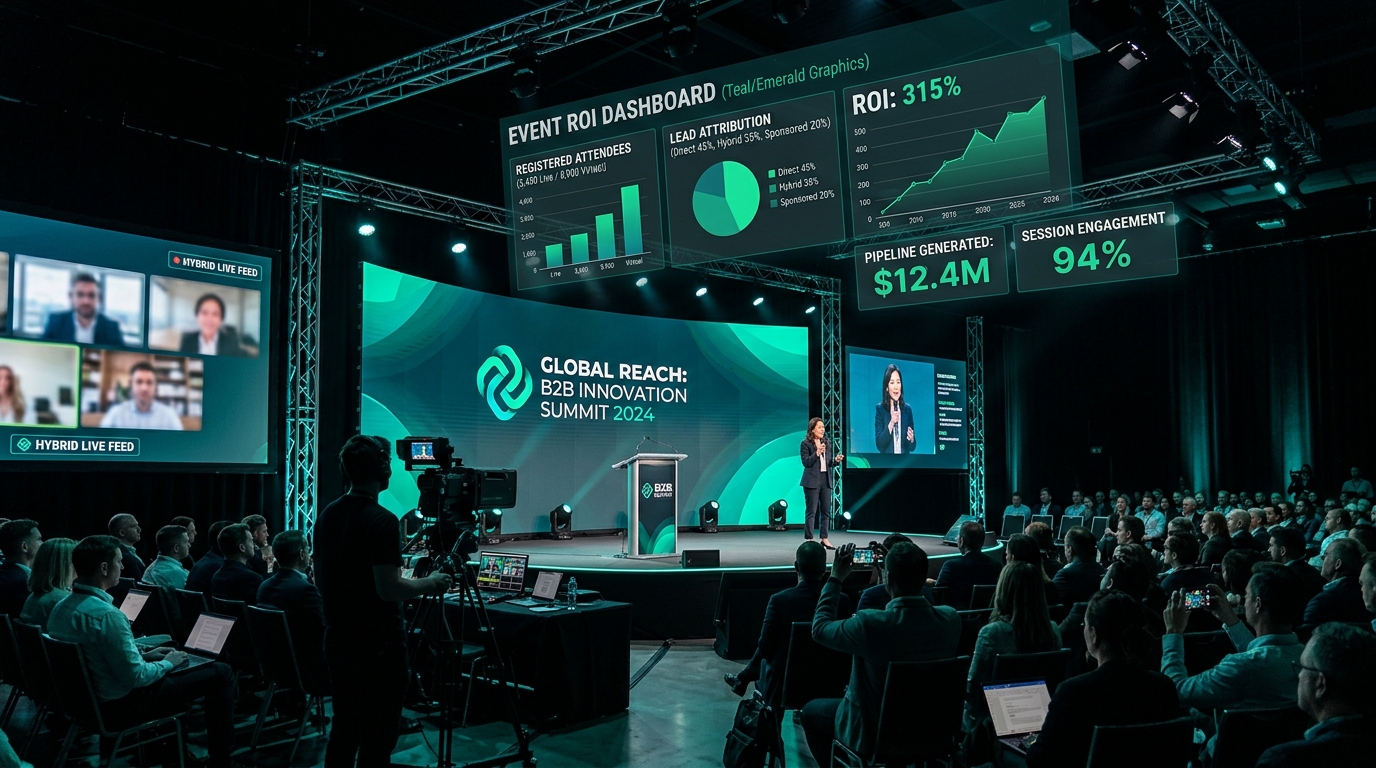
Events consume anywhere from 20% to 30% of B2B marketing budgets. You know they work—the sales team swears by the conversations they have on the floor, and your webinar engagement rates are through the roof. But when the CFO asks for the exact ROI of that $100k Platinum sponsorship or your virtual summit series, you're left pointing to "brand awareness" and lead counts.
Let's be blunt: in 2026, counting badge scans or registration volume isn't just lazy; it's a fast track to getting your event budget slashed.
At Sotros, we've audited dozens of enterprise event strategies, and we see the same fundamental flaw repeatedly. Teams treat events as standalone lead generation engines rather than high-touch accelerators within a complex buyer journey. They rely on single-touch attribution models that either wildly overcredit the event or ignore its impact entirely.
Here is the reality check: lead generation has dropped to roughly the fifth priority for modern B2B events. Customer engagement and pipeline acceleration are now the main game. If you're still measuring success by cost-per-lead at a trade show, you are playing the wrong sport.
This playbook breaks down how to actually measure B2B event ROI—whether virtual, hybrid, or in-person. We’ll cover the shift from event-sourced to event-influenced pipeline, why your CRM integration is likely broken, and the attribution frameworks that actually reflect reality.
The Big Shift: Sourced vs. Influenced Pipeline
Historically, event marketers obsessed over "event-sourced" pipeline. The logic was simple: we met them at the booth, we uploaded the CSV, they became an opportunity, boom—event revenue.
What we actually see in the data is that pure event-sourced pipeline is rare in complex B2B sales. Buyers are almost never encountering your brand for the very first time at a massive industry conference. They've likely seen your ads, read your content, or engaged in dark social channels.
Instead, the goldmine is event-influenced pipeline.
When we look at top-performing virtual and hybrid event programs, they target a 5x to 8x ROI in influenced pipeline. For closed-won revenue, the average ROI sits between 2.5x and 4x within a standard 6-month attribution window. If you aren't measuring influence, you are underreporting your event ROI by magnitudes.
The Problem with Single-Touch (And Why It Must Die)
If your event platform just passes a "Lead Source: Event" tag to Salesforce and calls it a day, you have a major attribution blind spot. Single-touch attribution (first-touch or last-touch) is completely obsolete for B2B events.
Why? Because B2B buying groups consist of 6-10 stakeholders. The person who attends your webinar is rarely the ultimate economic buyer. If you use last-touch, you ignore the webinar. If you use first-touch, you ignore the field dinner that closed the deal.
To fix this, you need multi-touch models. We strongly recommend exploring the W-Shaped Model for SaaS or adopting time-decay and position-based frameworks. These models distribute credit across the entire journey, acknowledging that the massive virtual summit played a critical role even if it wasn't the first or last interaction.
ROI Expectations by Event Format (2026 Benchmarks)
Not all events are created equal, and your ROI expectations need to reflect the format. Here is what the data tells us across the core event types.
1. Webinars and Virtual Summits
Virtual isn't dead; it just matured. The pandemic hangover is gone, and what remains is a highly efficient, high-ROI channel if executed correctly.
- Average ROI: 213% across B2B.
- SaaS Peak: B2B SaaS companies frequently see peaks up to 430% ROI for targeted, high-intent virtual events.
- Attendance vs. On-Demand: Industry-leading live attendance rates hover around 55% (compared to ~25% on standard legacy platforms). But the real story is on-demand. On-demand engagement rates regularly exceed 75%. If your attribution model doesn't capture on-demand viewing data over a 90-day tail, you are bleeding ROI.
Pro Tip: For deep dives into setting up proper tracking for digital interactions, check out our guide on GA4 Attribution for B2B SaaS.
2. In-Person Conferences and Trade Shows
The granddaddy of event marketing. These are expensive, resource-heavy, and notoriously difficult to measure.
The mistake most teams make here is treating the event as a three-day sprint. We preach the 40-20-40 heuristic:
- 40% of the ROI comes from pre-show targeting and meeting booking.
- 20% comes from the at-show execution.
- 40% comes from the post-event follow-up sequence.
If you blow your entire budget on the booth build and have zero budget left for targeted pre-show outreach or aggressive post-show retargeting, your ROI will tank.
3. Hybrid Events
A quick hot take: Hybrid events are no longer the default. During the transition years, everyone tried to run hybrid events, essentially doubling their workload for mediocre results on both sides. In 2026, hybrid is used selectively. You run a stellar in-person event, and you package the VOD (video-on-demand) content as a virtual campaign later. Trying to stream every breakout room live is an expensive distraction.
The Blueprint: Building Your Event Attribution Engine
To actually capture this data, you need infrastructure. You cannot run event ROI on vibes and spreadsheets. Here is the technical foundation required to prove value.
Step 1: Bidirectional CRM Integration is Non-Negotiable
Most event tech stacks push data one way: from the event platform (like Cvent, Bizzabo, or Hopin) into the MAP (Marketo, HubSpot) and then to the CRM (Salesforce).
This is insufficient. You need bidirectional sync. Your event platform needs to know if a registrant is currently an open opportunity, a tier-1 target account, or an existing customer up for renewal. This allows you to trigger real-time alerts to account owners when their targets log in or scan their badge.
Step 2: Implement Campaign Hierarchies
Never dump all event leads into a single CRM campaign. Build a hierarchy:
- Parent Campaign: "Q3 Field Marketing"
- Child Campaign 1: "SaaStr Annual 2026 - Booth Scans"
- Child Campaign 2: "SaaStr Annual 2026 - VIP Dinner"
- Child Campaign 3: "SaaStr Annual 2026 - Pre-Show Direct Mail"
This granularity is what allows you to see that the VIP dinner drove 80% of the influenced pipeline, while the booth scans just drove unqualified noise.
Step 3: Self-Reported Attribution (The Dark Social Fix)
Because so much event discovery happens in Slack communities, WhatsApp groups, and private networks, software tracking will always miss a percentage of the truth.
You must implement "How did you hear about us?" (HDYHAU) fields on your high-intent demo request forms. When a prospect types, "I saw your CEO speak at the summit in Vegas last month," that qualitative data overrides any first-touch software attribution. Combining self-reported data with software tracking is the only way to get the full picture.
If you are struggling with broad marketing budget allocation, understanding the true source of your best customers via self-reported attribution will fundamentally shift where you invest.
4 Common Event ROI Mistakes (And How to Fix Them)
After managing 50+ enterprise accounts, we see the same pitfalls. Here is what to avoid.
Mistake 1: Treating All Leads Equally
A VP of Engineering who spends 45 minutes at your booth having a deep technical discussion is not the same as a junior developer who scanned their badge to get a free Yeti mug.
The Fix: Implement scoring mechanisms. Event leads should not be automatically routed to SDRs for a generic 12-step cadence. High-intent conversations must be fast-tracked to Account Executives with personalized context. Review our RevOps Metrics Framework to see how lead velocity should be measured.
Mistake 2: The "Ghost" Follow-Up
The event ends on Thursday. The marketing team takes Friday off. The list gets uploaded on Tuesday. The SDRs get to it on Thursday. By the time you reach out, the prospect has forgotten who you are.
The Fix: Pre-build your follow-up cadences. If your SDRs aren't sending emails from the airport on the way home, you are too slow.
Mistake 3: Ignoring Customer Expansion
As mentioned earlier, lead gen is no longer the top priority for events. Customer engagement is. Yet, most ROI calculations only look at net-new pipeline.
The Fix: You must track retention impact and upsell/cross-sell pipeline influenced by the event. If a $200k account was at risk of churning, and an in-person meeting at your customer conference saved the deal, that $200k belongs in your ROI calculation.
Mistake 4: Disconnected Content Strategy
Events generate massive amounts of content, but teams let it die on the vine.
The Fix: Repurpose everything. A single keynote should become three blog posts, a gated framework, and 15 LinkedIn clips. This extends the ROI tail of the event indefinitely. For more on maximizing content value, read How to Measure B2B Content Marketing ROI.
The Sotros Perspective
The days of blank-check event budgets are over. CFOs are demanding the same level of analytical rigor from field marketing that they demand from performance media.
If you want to protect your event budget, you have to prove that events accelerate revenue. Move away from single-touch models, embrace influenced pipeline as your core metric, fix your CRM architecture, and integrate self-reported attribution.
Stop optimizing for badge scans. Start optimizing for revenue.
Need help untangling your event attribution mess? Sotros Infotech specializes in building advanced RevOps and analytics infrastructures for B2B SaaS. Let's talk about turning your CRM into a single source of truth.
Need help with performance marketing?
Our team builds performance marketing systems for B2B companies. Get a free strategy review.
Book a Free Strategy CallFrequently Asked Questions
How This Fits Into Our Work
This article is part of how we deliver Demand Generation, Analytics and Lead Generation for teams in B2B and SaaS. If you're facing similar challenges, we can help you build the infrastructure to address them systematically.